
Information about the SPACE project - one-stop-shop for young people in BBSK
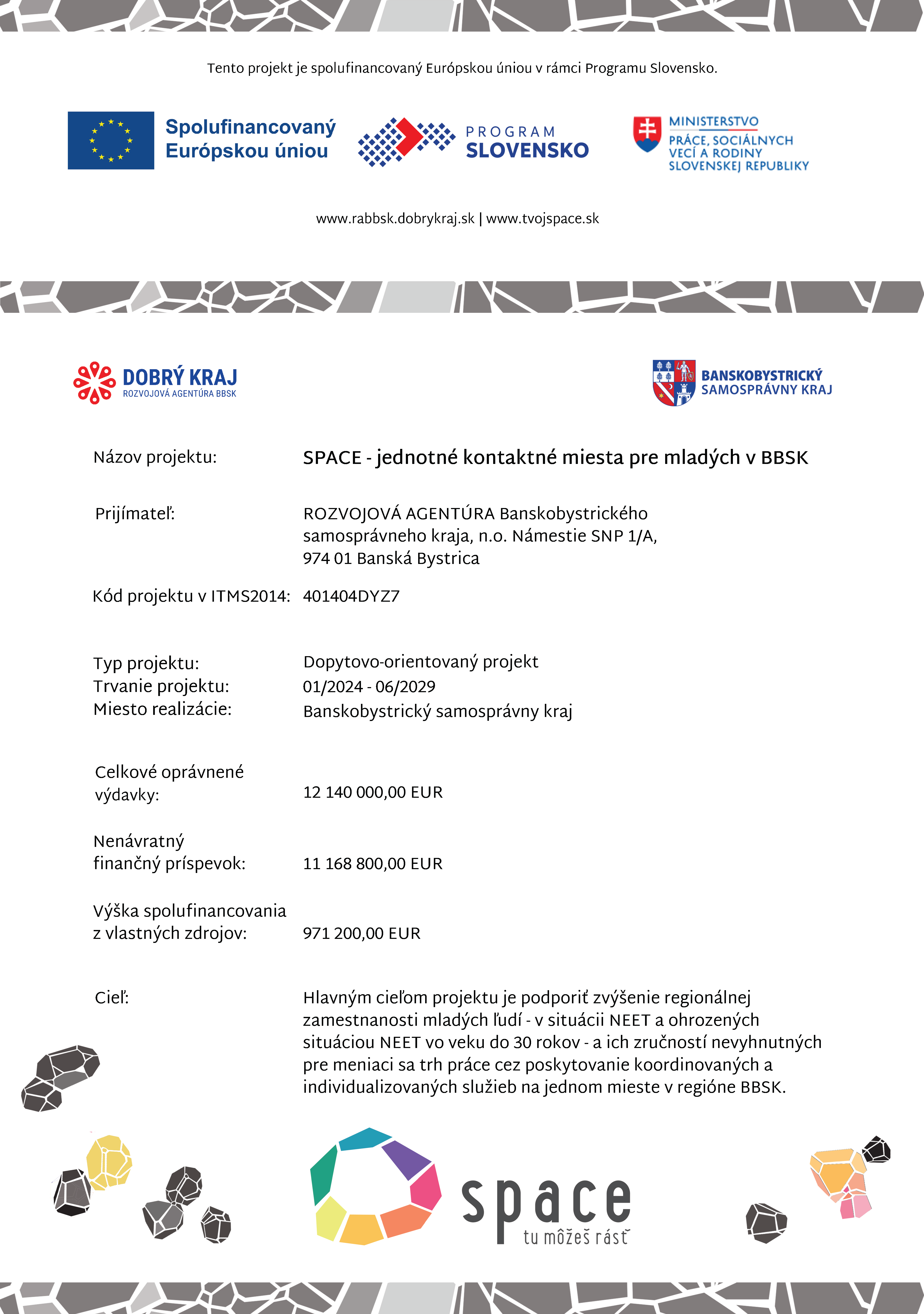
Information about the project
Priority axis: 401404 - 4P4 Youth Guarantee (Youth Employment)
Fund: ESF+
Specific objective: 401404059 - ESO4.12 Promoting the social integration of people at risk of poverty or social exclusion, including the most deprived persons and children (ESF+) - less developed
Call code: PSK-MPSVR-023-2023-DV-ESF+
Project code: 401404DYZ7
ŽoNFP code: NFP401404DYZ7
NFP Contract No Z401404DYZ7
This project is co-financed by the European Union under the Slovakia Programme.
AGREED AMOUNT OF NFA (NFA Contract No Z401404DYZ7)
Total Eligible Expenditure for the Implementation of the Project Activities
12 140 000,00 EUR
Maximum amount of the non-repayable financial contribution from EU and SF funds (92% of the total amount of eligible project expenditure in EUR):
11 168 800,00 EUR
Amount of co-financing from the beneficiary's own resources (8% of the total eligible project expenditure in EUR):
971200,00 EUR
References:
https://www.eurofondy.gov.sk/program-slovensko/index.html
https://www.employment.gov.sk
PROJECT DESCRIPTION
The main objective of the project is to support the increase of regional employment of young people under 30 years of age, in NEET situation and at risk of NEET situation, and to strengthen their skills necessary for the changing labour market through the provision of coordinated and individualized services in one place in the BBSK region. At the same time, the aim is to ensure sustainable and efficient functioning of the JKM thanks to the partnership principle, where under one roof professional staff from partner organizations/professions provide quality services in dealing with the complex life situation of people from CS, thus ensuring a holistic approach.
The target group (CS) of the project is, in the sense of the Council Recommendation on the Bridge to Jobs - Strengthening the Youth Guarantee: young people in NEET situation, aged up to 30 years, who are neither in employment nor in education or training; young people at risk of NEET situation: Primary and secondary school pupils, including those with SEN; young people with disabilities; young people from the MRC; young people, third-country nationals, including migrants; young people who have attained less than secondary vocational education; young parents; young adults leaving the CDR; young people who have completed a prison sentence. In the sense of the Council Recommendation establishing a European guarantee for children: children in need. The output of the project will be measured through MU PO113 - Number of people providing social or support services, with a planned number of 62. The outcome of the project will be measured through MU PR074 - Clients who have used services, with a planned number of 14 800 within 8 JMCs.
Main activity: Establishing JMCs and ensuring their sustainable and effective functioning
The main activity will be implemented throughout the project implementation period through three sub-activities:
- Ensuring sustainable and efficient functioning of existing SPACE JMCs for the provision of existing services on a partnership basis, or the establishment of new SPACE JMCs: - This involves upgrading the existing seven SPACE JMCs in BBSK by applying approaches based on good practice from abroad and the establishment of an eighth SPACE JMC. In particular, it is about securing experts from partner organisations to provide services on a regular basis in the JKM premises.
- Establishment of teams of youth workers of the JKM: - Their main task will be to promote the intrinsic motivation of young people and their independence, this is a very loose part of the youth work model (they are employees of the JKM, they are central figures in working with the target group and orienting them to the JKM, to specific services, or to workshops (if they exist, or to similar services with the aim of acquiring work habits). Their basic role is to gain the trust of the CS, to ensure a sense of security in the CS and to provide motivation to start thinking about solutions to their situation, all voluntarily and without coercion).
Establishment or cooperation in the creation or operation of youth workshops for work skills: - Establishment of youth workshops in cooperation with relevant partners - the workshops have an informal, friendly and relaxed component, and are specialised in work, study and social skills
JKM SPACE tasks in BBSK:
- Networking and collaboration, not only between JKM and partners, but also between individual clients, e.g. networking young people who would like to do business and successful entrepreneurs in the region.
- Defining procedural steps in working with young people
- Defining how to work together and the clear responsibilities of each partner.
- Providing skills testing, if the CS person agrees, especially IT skills, with the testing only being a tool to identify the specific needs of clients and suggest specific types of training opportunities/courses to supplement skills.
- Co/outreach and fieldwork with young people. Supporting and guiding young people in JKM and in the field.
- Flexibility, adapting services to individual needs. Strengthening young people's self-esteem and motivation.
- Ensuring and increasing the effectiveness of the JKM model so that as many CS persons as possible achieve a sustainable and quality solution according to their wishes in the shortest possible time, but keeping in mind the individual approach of maintaining the confidence of CS persons. Numbers must not impact on quality.
The main contribution of the JKM is the holistic and coordinated approach where the different actors complement each other and jointly plan the different steps in supporting young people in NEET situation. Working with a person from CS can take a short period of time, but can also take several months or years. The role of the CSC will be to create partnerships that enable the CSC to provide all the necessary types of services to address the individual situation of young people, while at the same time providing prevention for young people at risk of becoming NEET. The JMCs will focus on young people who are inactive, as they are not registered with the labour offices and thus do not have access to employment services. The number of inactive young people has increased over the last ten years and now represents the majority of young people in NEET situations.
The project implementation site is the BBSK territory (8 selected BBSK districts) with a planned duration of 66 months, from 1/2024 to 6/2029.
BBSK Development Agency, n. o.
Námestie SNP 14585/1A
97401 Banská Bystrica
info@dobrykraj.sk
+421 947 798 494

